At 39, Carlos Luna measures victory differently than he once did.
Known throughout the padel world as “Charlie Moon,” the former professional athlete spent years competing at an elite level. Today, after five battles with cancer, a bone marrow transplant, CAR T-cell therapy and periods when survival itself seemed unlikely, simply stepping onto a court carries a different meaning.
“For me, it is now impossible to truly lose a match,” Moon says. “If I can walk onto the court by myself, hold a racket, and hit a ball, I have already won something much greater than any match.”
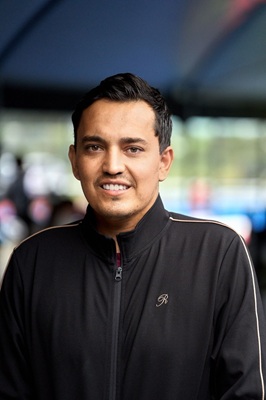
It is a perspective shaped by a leukemia journey that begins in December 2019 and eventually brings Moon to Sylvester Comprehensive Cancer Center, part of the University of Miami Health System.
Moon was living in London when he received his first diagnosis. Until then, serious illness had been foreign to him.
“The news came as a complete shock because I had never experienced a major illness before,” he says. “Strangely, the diagnosis itself was not what hurt me most. What devastated me was being told that, even if I survived, I might never play padel again.”
His life quickly became a cycle of treatments and relapses. He sought care in multiple countries, endured severe complications and, at different points, spent time in intensive care. By May 2024, when the cancer returned yet again, Moon had little desire to continue treatment.
He left Miami for his native Ecuador, expecting to spend his remaining time there.
“I was physically and emotionally exhausted, and I felt that I had reached my limit,” he says. “I left Miami and flew home to Ecuador because I wanted to spend my final days peacefully in my own country, surrounded by the people and places I loved.”
Then came a connection to the team at UHealth and Sylvester Comprehensive Cancer Center. Moon returned to Miami for what he considered one final attempt.
Treating a Difficult Relapse
By the time Moon arrived at Sylvester, his leukemia had already returned multiple times.
Dr. Sangeetha Venugopal, a hematology oncologist at Sylvester Comprehensive Cancer Center and one of Moon’s physicians, says the repeated relapses sharply reduced the likelihood of achieving another remission.
“Carlos came to us in this third relapse, which means that he has already received several lines of chemotherapy,” Venugopal says. “Each time leukemia relapses, the remission rate decreases sharply, so by the third relapse, the chances of achieving a remission are less than 20%.”
Another complication was the lack of detailed information about his previous treatments. That limited the team’s ability to use anthracycline because of concerns about cumulative exposure and cardiotoxicity.
There was, however, an opening.
“Fortunately, his leukemia expressed CD22, which allowed us to use inotuzumab, a targeted antibody against CD22,” Venugopal says.
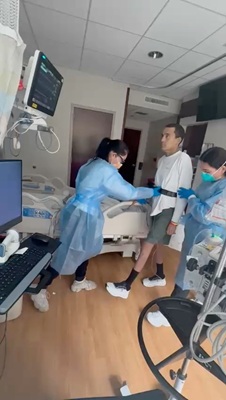
Moon ultimately undergoes a bone marrow transplant and CAR T-cell therapy. Venugopal describes bone marrow transplantation as a curative-intent treatment, while CAR T-cell therapy can be used when acute lymphoblastic leukemia, or ALL, relapses after transplant.
His case also reflects how dramatically treatment options for difficult blood cancers have expanded.
“In the past decade, we are gradually moving away from chemotherapy-dominant regimens to precise, immunotherapy-integrated and chemotherapy-free approaches,” Venugopal says. “In particular, Bispecific T-Cell Engagers (BiTEs) such as blinatumomab, Chimeric antigen receptor (CAR) T-cell therapies, Antibody-Drug Conjugates such as inotuzumab ozogamicin have ushered in an era of incremental survival benefit in patients with ALL.”
The Battle Beyond the Disease
Moon’s experience also leaves scars that are harder to see.
During his fourth battle with cancer, the disease spread to his bones. He describes intense pain, depression and periods when he thought about ending his life.
“That experience helped me understand that many people experiencing suicidal thoughts may not truly want their lives to end; they desperately want the pain of that particular moment to stop,” Moon says. “They want the darkness to turn off because they cannot see another way out.”
He now speaks openly about emotional health and the pressure some men feel to conceal fear or vulnerability.
“Asking for help is not weakness,” he says. “Expressing fear, pain, or sadness can be the first step toward freedom and healing.”
Recovery from intensive leukemia treatment can itself take years. Venugopal says patients generally regain physical strength first, followed by psychological and social recovery.
“In general it takes at least 2-3 years post-transplant to regain the quality of life,” she says. “When patients are motivated and they follow a reasonably personalized physical rehabilitation, their recovery period is remarkably shortened.”
For Moon, that recovery has brought him back to padel—and to the Reserve community in South Florida, which rallied around him throughout his treatment.
The sport he once played professionally is also becoming increasingly visible in the United States, with South Florida emerging as one of its hubs. Moon no longer expects his body to perform exactly as it did before cancer. That matters less to him now.
“I may not compete at the same level I did before, and my body may cramp or become tired afterward, but I choose to focus on the miracle of being able to move on my own,” he says.
Turning a Comeback Into a Mission
Moon’s return to the court is now tied to another goal: helping patients who are still fighting.
On November 6, Reserve Cares, the philanthropic arm of Reserve Padel, will host the second annual Moonlight Open in South Florida, raising money for leukemia research at Sylvester.
The event was created by Reserve Founder and CEO Wayne Boich and the Reserve Cares team as the padel community rallied around longtime Reserve player and friend Charlie Moon during his treatment. Moon, who has long been part of the Reserve community, developed a close friendship with Boich through the sport. What began as a show of support for a friend has since grown into an annual fundraising initiative supporting leukemia research and patients and families affected by blood cancers. The inaugural Moonlight Open raised nearly $1 million in just 12 days.
Moon was in the ICU during that first tournament.
“Knowing that Reserve had brought the community together in my honor gave me happiness, motivation, and strength,” he says. “It reminded me that I was not alone and helped me continue fighting.”
The experience helped shape what he wants the event to become. He sees it not simply as a fundraiser, but as a message to people experiencing the isolation he knows well.
“The Moonlight Open, created by Reserve Cares, is for everyone currently fighting cancer,” Moon says. “It is also for those we have lost physically but continue carrying in our hearts.”
More than five years after his first diagnosis, Moon is again holding a racket. The athlete who once measured success through rankings and competition now plays with an awareness that every trip onto the court is something he once feared had been taken from him forever.
“I love this sport more than ever, and I enjoy every opportunity to play as though it could be my last,” he says. “Life taught me that we never know when we may do something we love for the final time.”
And for the patients still waiting for their own chance to return to the life they knew, Moon hopes the Moonlight Open delivers something just as valuable as the money it raises.
“If the Moonlight Open can provide someone with hope during their darkest moment and help them believe that they still have one more fight left, then everything we are doing will be worth it.”
For more information, visit med.miami.edu.