
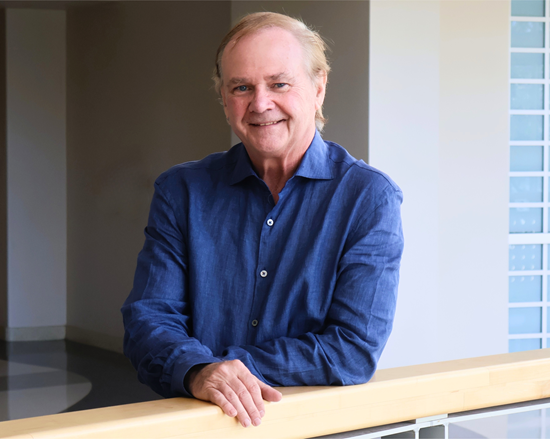


Howard K. Butcher, RN, PhD, FAAN
By Daniel Casciato
As healthcare grows more complex, the need for rigorous nursing research grounded in compassion and human experience has never been greater. From improving care for an aging population to transforming healthcare environments, nurse scientists play a critical role in shaping the future of care delivery.
At Florida Atlantic University’s Christine E. Lynn College of Nursing, doctoral education is rooted in a philosophy that integrates scientific inquiry with caring science. Now in its twentieth year, the Doctor of Philosophy with Major in Nursing (Ph.D.) program prepares nurses to generate new knowledge that advances practice, informs policy, and improves health outcomes across diverse communities.
A Doctoral Program Grounded in Caring Science
Under the leadership of Howard K. Butcher, RN, PhD, FAAN, the program emphasizes research that is both methodologically rigorous and deeply grounded in human dignity, compassion, and real-world impact.
“Caring philosophy integrates the art and science of nursing,” Dr. Butcher says.
This framework encourages scholars to examine complex health challenges by considering the experiences of patients, families, and communities. “Caring science guides our Ph.D. students to ask questions that are grounded in human experience and real-world impact, not just technical skills,” Dr. Butcher explains.
Many foundational caring theories used in nursing education and research globally were developed by faculty at the college, shaping how doctoral students design studies, interpret findings, and translate research into practice.
“Caring science provides a structure for research that remains centered on compassion, mutual healing, and human dignity,” he says.
The college’s educational culture was shaped by Dr. Anne Boykin, the founding dean of the college and a nationally recognized caring science scholar. Today, resources such as the Anne Boykin Institute for the Advancement of Caring Science and the Archives for Caring continue to support doctoral education and research.
This emphasis on caring science shapes not only how students conduct research, but how they apply it beyond the academic setting.
Preparing Nurse Scientists for Real-World Impact
The Ph.D. program prepares nurse scientists, educators, and leaders who apply this philosophy across a range of settings. While many graduates pursue academic careers in research and teaching, others conduct patient-centered clinical research or work in areas such as healthcare administration, health policy, data science, biotechnology, and consulting.
“I see graduates of our Ph.D. program as stewards of the nursing profession,” Dr. Butcher says. “The program equips them to address real-world nursing and healthcare challenges with both scientific rigor and a deep commitment to improving human well-being.”
Traditional Doctor of Nursing Practice (DNP) programs are practice-focused and designed to prepare nursing leaders who improve care delivery and health outcomes by translating existing research into practice. In contrast, a Ph.D. in Nursing prepares nurses to generate new knowledge through original research that shapes nursing practice, education, policy, and healthcare systems.
While Ph.D. programs are research-centered, their impact extends well beyond academia. Nurse researchers design and lead funded studies implemented in clinical and community settings, influencing patient care, population health, and system-level decision-making. At the same time, many DNP-prepared nurses are increasingly interested in deeper research training to contribute to generating evidence, not just its application.
As a result, there is growing interest in dual DNP/Ph.D. pathways that prepare nurses to function as both advanced practice clinicians and nurse researchers, strengthening the connection between practice and discovery.
“Within this broader landscape of doctoral nursing education, the Ph.D. program at the Christine E. Lynn College of Nursing is also distinguished by its grounding in caring science,” Dr. Butcher notes.
That philosophy is embedded throughout the curriculum.
“Our Ph.D. students complete three required caring science courses that integrate theory development, systematic inquiry, and research methods specific to advancing caring-based scholarship,” he says.
The program offers entry tracks for nurses with a Bachelor of Science in Nursing, Master of Science in Nursing, or Doctor of Nursing Practice. Coursework is completed over two years, followed by mentored dissertation research.
“Our doctoral students are taught to analyze gaps in care, engage in interprofessional collaboration, and create innovative, evidence-based solutions that improve patient outcomes, enhance community health, and influence healthcare policy.”
Research Priorities Addressing Today’s Healthcare Challenges
Healthy aging, health equity, holistic health, and transforming healthcare environments are the four research areas the College prioritizes, because they align with faculty research expertise and the most urgent challenges facing healthcare today.
Healthy aging reflects the growing needs of the global aging population, with research focused on improving quality of life, supporting independence, and helping older adults navigate the physical, emotional, and social challenges of aging. This work is especially relevant as healthcare systems adapt to longer life expectancy and rising rates of chronic illness.
Health equity is a critical focus, particularly in South Florida’s diverse communities. Research in this area examines factors that influence health outcomes and access to care, with the goal of developing and testing interventions that improve patient outcomes across settings. Grounded in caring science, this work emphasizes ethical responsibility, community engagement, and ensuring that all individuals can achieve their highest level of health.
“Caring science is inherently holistic, meaning mind, body, emotions, spirit, and environment are viewed as an integral unity,” Dr. Butcher says, adding that the Christine E. Lynn College of Nursing is the only nursing college in the nation with all degree programs certified in holistic nursing by the American Holistic Nursing Association.
“Our college has a long tradition of educating nurses in a holistic nursing perspective,” he adds. Research in holistic nursing is becoming increasingly important because of its emphasis on prevention and health promotion, noninvasive healing modalities, and quality of life.
Lastly, transforming healthcare environments addresses the systems in which care is delivered. Research in this area focuses on improving organizational and administrative processes, strengthening interprofessional collaboration, integrating technology, and creating healthier work environments for nurses and patients. These factors directly influence care quality, patient satisfaction, and health outcomes.
Together, these four areas reflect a comprehensive approach to nursing research that connects individual patient care with community needs and healthcare system transformation.
Advancing Nursing Through Research and Compassion
There is a growing recognition that caring science is central to nursing—and its influence continues to expand. In 2021, the American Nurses Association updated its definition of the profession to include it, reflecting a broader shift toward emphasizing the human, relational, and holistic aspects of care.
Ph.D. graduates from the Christine E. Lynn College of Nursing, trained in rigorous research methods and grounded in caring science, are uniquely positioned to translate these principles into measurable improvements in patient outcomes, develop evidence-based interventions that address complex health challenges, and inform policies and practices that shape nursing education and healthcare delivery.
Learn more and apply to the Christine E. Lynn College of Nursing Ph.D. program at fau.edu/nursing/academics/phd-program. The Fall 2026 application deadline is March 15.























