Few would argue that hospital medical and management staff is mostly stable. Yes, there is change, however it is incremental over time and not wholesale alteration. Imagine participating in a complete medical and management staff change every 7 days.
That was the case with the University of Miami’s Project Medishare Field Hospital Haiti. Hard working and dedicated volunteers comprised the entire staff model of this hospital. This paper discusses the challenges of building an organization able to withstand the rigors of constant human resource change and leadership from the bottom up in extreme conditions.
Day 4 of the tent field hospital Port-au-Prince airfield: 600 people within the camp and no toilets, no showers, no dumpsters, no sewers, no trash collection. The air was unmistakably heavy and rank. As I rose from my spot in the dirt that morning, this was the realization of the leadership that lay ahead: How can I lead this facility to care for the legions of patients and administrate this facility safely?
Lesson #1: Provide a clean, safe environment for everyone in your facility.
A critical component of any healthcare organization is safety. Here, hygiene is a primary factor; clean water, ample food, and sanitary facilities. While simple and taken for granted in the U.S., in Haiti, these limited or non-existent resources pose safety risks and prove quite a challenge. Adding to the complexity was the need to create solutions for the culturally different needs of the population within the camp — roughly 400 Haitians and 200 U.S. volunteers. Of the Haitians, this was comprised of patients, family members and workers, and of the volunteers, doctors, nurses and logistics staff. The solution for the Haitians was to prepare an area outside the medical tents for the family members in slit trench latrines, privacy walls for showers, and the use of discarded tent boxes for liquid bio-hazardous waste. Emptying bed pans just outside the door of the hospital was not acceptable. For the volunteers, not much was different — slit trench latrines, male urinal tubes, crude plywood showers. Fence the perimeter with 24 hour armed guards. Finally, the proverbial “Don’t drink the water” took on a whole-new sobering meaning.
Lesson #2: Know your mission, identify your strengths and weaknesses, and be able to communicate this precisely and confidently to your team.
Each group of new volunteers brought with them new fresh energy and different management ideas. Leading a facility undergoing constant change management is no picnic. Management change is challenging to the psychological well being of many workers, and can possibly contribute to inefficiency and frustration. This was the leadership lesson and the administrative task: how to establish and set protocols, procedures, and standards that could work with the ever changing self-actualized group of independent thinkers known as volunteers. This daunting task Included where and how to use the crowded facilities, eating and staying hydrated, creating medical records, death procedures, overcoming fatigue, language barriers, limited supplies, limited labs, limited diagnostics and unlimited patient volume and managing the ever-present security risk. The first task was personal — to understand the realities of a field hospital in a foreign land. There are many needs in this environment, but above all else lies patient care. If I was not able to articulate the realities, needs and differences to myself, then attempting to articulate this to 200 volunteers every week was not possible. The first big realization was adjusting my expectations of what could be done medically and physically, and then reconciling the ethical effect of this new expectation. Providing structure and communicating these expectations and realities each week was a key factor to success and to my own well being. The morgue has no air-conditioning.
Lesson #3: Leadership means recognizing it’s time for change, finding the courage to plan a change when conditions are utterly intolerable, and effectively implementing change even with there is resistance.
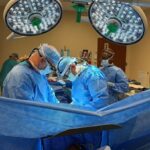
Project Medishare Field Hospital was the largest hospital in Port-au-Prince and provided the most technologically advanced healthcare facility Haiti had ever seen. From our three, and at times, four general ORs and the NICU, PICU, ICU, Lab, Pathology, and Medical Surgical units, our capabilities were remarkable. However, despite this achievement, our limited resources and lack of a sterile environment taught us that we couldn’t do everything for everyone. The truly amazing thing proved to be that we were able to make the most out of what we had: excellent medical skills, resourcefulness, hard work, tenacity, and an ideology that we could do what was needed. And we did. One reality of working in this environment included the understanding that everything required twice the effort for half the results.
The personal and professional gratification and growth I experienced is humbling to say the least. It’s easy to stay in the limelight when “It’s all good.” But leadership demands this gratification to be fleeting. Some call it “don’t rest on your laurels.”
Recognizing the changing environment from crisis care to general healthcare, (patient population), political and social change, (market), and financial constraints, (managing to a budget) all should signal to the leader to keep looking over the horizon.
Project Medishare Field Hospital was a 20,000 square foot fabric tent in a dirt field prone to flooding. Working conditions in our “office” was often over 110 degrees with ever-present jet aircraft noise and the acrid smell of jet exhaust. Even a simple one-on-one conversation required a private walk in the blazing sun. Executing higher levels of leadership and administration, such as preparing a business plan in these conditions, was no small feat.
Project Medishare Field Hospital at its peak was a 220 bed acute care and trauma hospital, treated or saved over 20,000 patients, performed over 1500 major surgical procedures. Employed 240 local workers, and housed over 3,000 volunteers from all over the United States.
Special recognition and thank you to Dr. Barth Green, Chief of Neurosurgery University of Miami. Dr. Green is the Founder and Visionary for Project Medishare and possesses ability to ‘Never Quit” like no man I have ever known.
Inquiries to donate may be made at www.Projectmedishare.org.