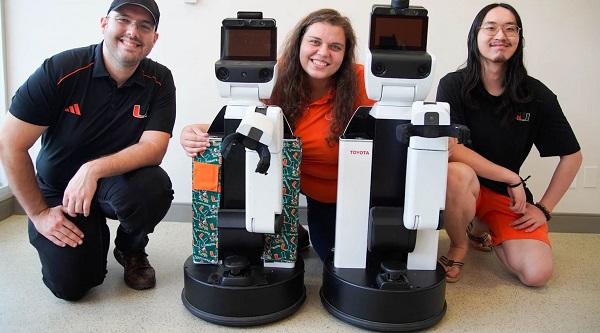
Researchers in the College of Arts and Sciences’ robotics program are developing software for an autonomous household robot that could help care for the elderly.
By College of Arts and Sciences University of Miami – Are robots the future of eldercare? by College of Arts and Sciences University of Miami – College of Arts and Sciences
While this might sound like something out of a science fiction movie, Visser and his students are already developing software for an autonomous household robot able to perform tasks like bringing an elderly person water and reminding them to take their medication.
These are simple tasks for a human, but for a robot, they require complex abilities such as understanding human speech and recognizing and manipulating objects.
Take, for example, fetching a bottle of water. A robot must first understand the request, then locate the kitchen, travel there safely, open the fridge, recognize the water bottle, grasp it, and bring it to the human. And that’s not all.
“The robot has to have an appropriate way of communicating with a human, meaning looking in the human’s eye, building rapport, being understanding, and reflective listening,” Visser said. “You might think, ‘That sounds easy.’ But it’s pretty much the hardest task.”
.jpg?auto=webp)
.jpg?auto=webp)
.jpg?auto=webp)
.jpg?auto=webp)
The RoboCanes team encountered unexpected navigation errors at this year’s competition, which prevented them from advancing, but in recent years they have ranked as the best team in North America and among the top five in the world. Regardless of the competition outcome, RoboCup provides students with an opportunity to test their research outside the lab.
The high-pressure situations teams encounter during competitions also teach students to work well under pressure. This is a highly sought-after ability in the robotics and artificial intelligence (AI) job market, said Visser, who founded the RoboCanes team in 2010 and was recently named president of the RoboCup Federation, which runs the RoboCup competitions and an international symposium. Former RoboCanes have gotten jobs at companies like Google Brain, Toyota Research International, and Volkswagen.
The research and competitions are important parts of the robotics program, but students also discuss ethical issues. While Pasternak, Ojalvo, and Duarte said they believe robotics and AI will help humans more than it harms them, they are in favor of regulations to lower the risks that bad actors could misuse the technology.
.jpg?auto=webp)
.jpg?auto=webp)
“When the worldwide web first came out, we called it the ‘wild west,’” said Duarte. “You wait 10 years and there are regulations that come out and now it’s more civilized.” With AI and robotics, he added, “You do have to worry about bad actors now at the beginning, but afterwards, it will become regulated.”
Concerns about the potential for harm could keep humans from allowing autonomous robots into their homes until long after they are widely used in rescue operations and other environments.
“I think homes are probably the last place that they’re going to get integrated,” Ojalvo said. “I think that’s going to take a long time, not necessarily for the technology, but for people to be willing to allow robots into their homes.”
Eventually, though, the researchers expect that humans will employ robots in numerous contexts.
“There are applications almost everywhere,” said Pasternak. Within their labs and in the RoboCup competitions, she added, computer scientists are talking about not only “What do we want to see in the research?” but also “What do we want to see in the world?”