.jpg) This September, Broward Health Coral Springs will be opening a new, four-story, 112,000 sq. ft. patient tower that will expand its surgical, women’s and children’s services. The expansion is the largest addition since the facility opened in 1987 and is designed to align hospital services with the needs of a growing community.
This September, Broward Health Coral Springs will be opening a new, four-story, 112,000 sq. ft. patient tower that will expand its surgical, women’s and children’s services. The expansion is the largest addition since the facility opened in 1987 and is designed to align hospital services with the needs of a growing community.
“The cities of Coral Springs, Parkland and Coconut Creek in northwest Broward have all seen tremendous growth, and we needed to have the ability to meet the demands of the community and its residents,” explained CEO Jared Smith. “We are the go-to facility in northwest Broward for emergency care services, surgical care and women and children’s services, and we want to continue to provide the next level of care.”
Broward Health Coral Springs serves approximately 20,000 children through its Emergency Department each year, and also treats children through its pediatric hospital and Level 2 neonatal care unit. According to Smith, the hospital offer obstetrics, a gamut of gynecological services including gynecologic oncology, uro-gynecology and women’s care from a breast cancer perspective, and GI and other subspecialties.
“We provide the full continuum of care, taking care of women for their entire lives,” he explained.
 The new $65 million tower will increase bed capacity from 200 to 250, and house the Mother/Baby program and medical and surgical patient rooms. The first floor will house the maternity suite with 12 labor and delivery rooms, a dedicated triage and recovery area, and C-section rooms and support areas. An elevator will provide a direct connection between the maternity suite and the Salah Foundation Children’s Hospital advanced level II neonatal intensive care unit, which will be located on the second floor along with 28 new, private post-partum rooms.
“The tower will allow us to offer everything in one convenient location,” said Smith, noting that the new building is located adjacent to the main building.
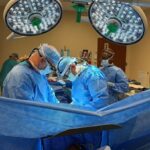
The third floor will hold the new medical/surgical wing with 28 patient rooms, and the fourth floor will be shelled out for future projects. “We are also adding innovative technology such as advanced robotics in our operating rooms for urology, oncology and general surgery, and state-of-the-art imaging,” said Smith. “We are laying the groundwork for future expansion, and are embarking on a plan to expand other services and programs.
 MGE Architects led the 16-month project. “We chose MGE because they are experts in the field with a wide-ranging knowledge of healthcare,” said Smith. “They are located in South Florida, so they also understand our population and its needs; they have a lot of experience in this type of environment.”
A number of events are slated for the tower’s opening, including public tours and open houses. “We started offering tours on Aug. 13, and have invited the public to come get a behind-the-scenes look at the new technology and state-of-the-art equipment in the tower,” said Smith. The hospital will also be holding open houses for local EMS providers and assisted living facilities, among others, and will officially open for service on Sept. 6.
“This has been a major project, and we couldn’t have done it without our partnerships with the city of Coral Springs, the mayor, and EMS,” said Smith. “This is a very exciting time for us.”
The Coral Springs tower is not the only building project that Broward Health Medical Center has recently undertaken. Its Salah Foundation Children’s Hospital in Fort Lauderdale is currently undergoing a $52 million renovation that will include a new Level 2 neo-natal care unit with 10 private rooms, and a dedicated children’s ER staffed by pediatric-trained physicians.
“The private rooms are designed to facilitate the healing process in a very calming environment,” said Smith. “It will be perfect for our most fragile babies, some of whom weigh only one kilogram at birth, or who are born at only 28 weeks. They need to heal and grow, and this environment is not only conducive to healing, but offers enhanced patient safety and reduced risk of infection, as well as advanced equipment including respirators and the Giraffe OmniBeds that most premature babies require.”
According to Smith, both hospitals’ expansions will benefit local patients. “Because we are in the same system, we can make sure that patients get the proper care in the right setting, depending on their needs,” he said of the facilities that are located 15 miles apart.