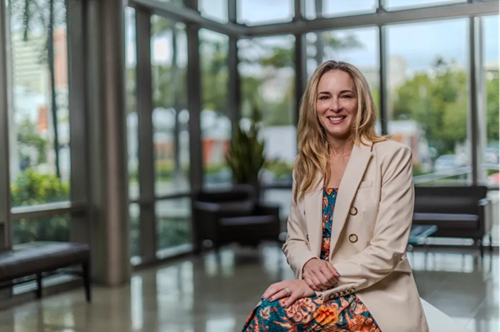
Award presented during the 2026 ASCO annual meeting in Chicago
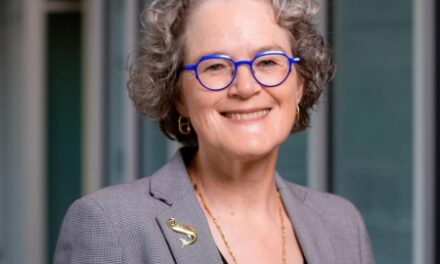
June 3, 2026 – Erin Kobetz, Ph.D., M.P.H., associate director for community outreach and engagement at Sylvester Comprehensive Cancer Center, part of the University of Miami Miller School of Medicine, has been named Healio’s “2026 Woman Disruptor of the Year.” The prestigious award recognizes a career defined by bold, community-driven cancer research, and an unwavering commitment to translating science into real-world impact.
Presented in partnership with Women in Medicine, the award honors female physicians and leaders who challenge the status quo and reshape oncology through innovation in research, care, advocacy and leadership. Dr. Kobetz, who also serves as vice president for health promotion and chief well-being officer at Sylvester, embodies that definition, not by disrupting for disruption’s sake, but by confronting questions others avoid and translating inquiry into measurable impact.
“I am not afraid to fail,” she said. “The real failure comes in not even attempting to ask the question. I’ve learned to embrace the discomfort that comes with uncertainty. It’s in those spaces that we stretch beyond our potential.”
That conviction has shaped Dr. Kobetz’s work. It underscores why Healio, a digital medical news and education platform for health care professionals, has named her its “Woman Disruptor of the Year.” Throughout her career, Dr. Kobetz, an epidemiologist and the John K. and Judy H. Schulte Senior Endowed Chair in Cancer Research, has built a research portfolio grounded in courageous inquiry, unconventional partnerships and a determination to push science beyond traditional boundaries in service of communities.
“When I look at the women I was nominated alongside and the impact they’ve made, I’m humbled to be among them, let alone to have won,” said Dr. Kobetz, “I’m grateful for the recognition and for the affirmation that making good trouble is worth it.”
Her leadership spans multiple roles across Sylvester, including serving as a principal investigator for multiple studies and co-director of the Clinical and Translational Science Institute. In that role, she helps build the infrastructure and capacity required to support multidisciplinary, team-based science, particularly work that prioritizes community engagement and relevance.
At the core of Dr. Kobetz’s approach are three defining commitments: elevating underrepresented voices, pursuing high-risk questions and building transdisciplinary teams to solve complex problems. While she is widely recognized for select initiatives, those efforts represent only a fraction of her overall impact. Much of her work is intentionally carried out behind the scenes, guided by the belief that disruption is not about recognition, but about whether the work advances.
That philosophy is evident in her early work in Little Haiti. Faced with disproportionately high cervical cancer rates in a community underserved by traditional screening models, Dr. Kobetz was cautioned against pursuing community-based research, which was viewed as too complex and unpredictable.
She chose a different approach: listening first.
What she heard was clear; existing screening strategies did not align with cultural norms or the realities of access. Rather than forcing conventional models, she partnered with community members to co-create new ones. Her team became the first to test HPV self-sampling outside a clinical setting, helping establish the evidence base that ultimately supported broader adoption and regulatory approval.
It was a defining moment, not only for its outcomes, but for its methodology.
“Working with communities gave me a tenacity and a hunger for relevance,” she said. “The innovation is already there, you just have to recognize it and elevate it.”
As the director and principal investigator for Sylvester’s Firefighter Cancer Initiative, that same mindset has guided her work with those in fire service, a population long concerned about occupational exposures and cancer risk but historically underserved by definitive data.
Rather than retreating from uncertainty, Dr. Kobetz leaned into it, reframing research questions around lived experience and real-world exposure. The resulting work advanced scientific understanding and helped inform policy and practice in a field where evidence had lagged behind concern.
“Sometimes the greatest opportunity presents itself through real challenge,” she said.
Dr. Kobetz’s influence extends beyond individual studies to how science itself is organized. Tasked with building Sylvester’s community outreach and engagement infrastructure, she began without a template, only a mandate to create meaningful, bidirectional partnerships.
Her solution inverted the traditional academic model. Instead of expecting communities to come to the institution, she brought science to them through mobile Sylvester Game Changer™ initiatives, requiring risk, investment and a fundamental redesign of access and trust.
“I approach everything as a transdisciplinary collaboration,” she said. “You create an intellectual sandbox where diverse perspectives advance shared priorities.”
That philosophy has enabled her to connect disciplines spanning cancer prevention, environmental exposure and population health into a cohesive, impact-driven research agenda.
“If you’re not moving forward, you’re standing still,” she said. “Progress requires evolution, and evolution demands momentum.”
Dr. Kobetz credits Sylvester for enabling that approach.
“From the time I was recruited, Sylvester leadership gave me the ability to dream big without boundaries,” she said. “When that is the expectation, being a disruptor isn’t optional, it’s essential. I’m committed to never falling short of that expectation.”
She describes an environment where ambition is matched with resources and where collaboration and curiosity are embedded into the institution’s structure rather than treated as aspirational ideals.
“Sylvester has given me the support and opportunity to pursue high-impact, truly disruptive science.”
Dr. Kobetz’s goals remain deliberately ambitious: advancing research on environmental drivers of cancer, leading statewide efforts to reduce cancer burden and contributing to the elimination of cervical cancer. These are structural challenges, not incremental ones.
“I’ve always believed that research can be a vehicle for social impact,” she said. “If that’s your north star, you have to push.”
As chair of the Florida Cancer Control and Research Advisory Council, Dr. Kobetz is working to align multisector stakeholders around measurable, statewide outcomes.
In honoring her, Healio recognizes not only a body of work, but a model of scientific leadership grounded in curiosity, courage and accountability to the communities science is meant to serve.
Dr. Kobetz is a disruptor not for disruption’s sake, but for impact.
Read more about Sylvester’s efforts to advance cancer research on the InventUM blog and follow @SylvesterCancer on X for the latest news on its research and care.