Providing medical students with the most comprehensive and cutting-edge curriculum possible is a goal that is forever evolving in todays rapidly changing medical education environment. As a result, Nova Southeastern University College of Osteopathic Medicine (NSU-COM) continually implements a range of programs that focus on enhancing each students clinical skills.
In 2008, the colleges Procedures in Clinical Medicine course for second-year students continued this custom by undergoing a fundamental makeover that incorporated more hands-on experiences, de-emphasized didactic lectures, and underscored a more-collaborative approach to teaching and learning. Incorporating clinical procedures has always been part of the training of our students, said David Thomas, M.D., J.D., who serves as course director and chair of the colleges Department of Surgery. However, this is a more unique and expanded clinical procedures course than weve done before because it includes five separate components.
A visiting resident demonstrates the insertion of a chest tube to an NSU osteopathic medical student.
The five modulesonline self-study, autopsy, mock OR, surgery, and medicine/cardiacallow the students to be exposed to a spectrum of information and procedures that will enable them to be more proficient with the hands-on aspect of medicine when they embark on their third-year clinical rotations.
The semester-long course kicked off with an eight-hour online self-study module that provided students with a range of background information before they actually performed any of the identified procedures. The six-hour autopsy module, which has been in existence for several years thanks to a cooperative agreement with both the Broward and Palm Beach County medical examiners offices, also underwent some significant tweaking. While participating in this component, students learned about the death certificate completion process, autopsy techniques and procedures, common problems encountered during an autopsy, and basic forensic pathology.
A resident physician supervises the insertion of a central line by a second-year NSU-COM student.
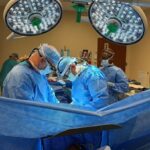
During a two-week period, the second-year students also had an opportunity to display their clinical skills by participating in an array of procedures spread over three distinct modules. First on the agenda was the four-hour mock OR segment, which was held for the first time in NSUs Mock OR. This unit included procedures such as proper hand washing, gowning and gloving, and sterile technique as well as inserting central lines and chest tubes into medical simulators.
Dr. David Thomas demonstrates cutting and suturing techniques as a second-year NSU-COM student watches intently.
Next up was the four-hour surgery module, which afforded students a chance to practice procedures such as suturing, laceration repair, and lesion removal in the Histology Lab. The fifth module medicine/cardiac was also held in the Histology Lab and involved a variety of simultaneous experiences, including blood draws, blood gasses, IV fluids, lumbar puncture demonstration, pulse oximetry, and glucometer use. Using a mix of medical simulators and each other to practice on, the students learned how to perform procedures such as becoming comfortable with drawing blood and inserting nasogastric tubes. In the future, the medicine/cardiac module will also provide medical simulators that will allow students to practice arthrocentesis techniques.
Another invaluable element was the inclusion of 12 residents from a range of hospitals, who played an integral role in the educational process by serving as trainers to the students. In addition to benefitting the students, it provided valuable lessons for the residents as well as the college. “One of the things medical schools are judged by is how well the beginning third-year students integrate into the hospital system during their clinical rotations,” Dr. Thomas explained. “A mutual feedback system between residents and the college is necessary because we dont always know what the hospitals consider important. With the residents participating in training our students under the supervision of clinical and full-time faculty members, there was a lot of positive interaction.”
Because the enhanced Procedures in Clinical Medicine course was well-received by all involved, the college has fully incorporated it into the second-year NSU-COM curriculum and has already purchased a cutting-edge I-Stan human patient simulator, which is a computer-driven, full-sized mannequin that delivers true-to-life scenarios that swiftly change to meet instructors goals.