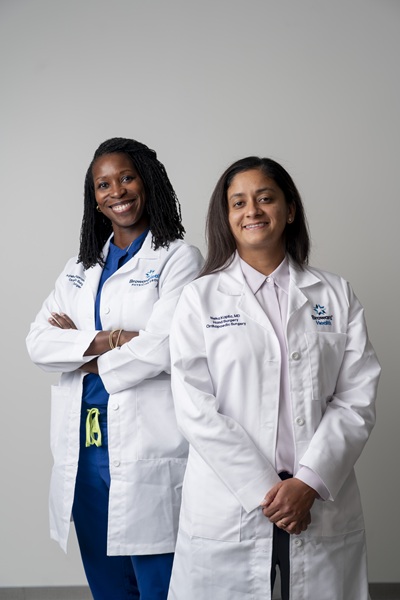
Dr. Livingston and Dr. Kapila
The recent addition of two orthopedic hand surgeons to the Broward Health Physician Group is elevating hand surgery at the health system.
The demand for hand care in Broward County has increased in recent years alongside an expanding population of older adults and the popularity of physical activities such as pickleball.
After long partnering with community physicians to treat patients with hand conditions, Broward Health over the past year welcomed orthopedic hand surgeons Neha Kapila, M.D., and Ayisha Livingstone, M.D., to the Broward Health Physician Group. Their additions complete the continuum of surgical and non-surgical hand care available at Broward Health.
“There was no hand surgeon on staff when I joined in October 2024,” Dr. Kapila said. “Since then, we’ve hired Dr. Livingstone, who joined this summer, because of our growing patient population. We see a lot of both chronic and traumatic cases, and we’re rapidly expanding our program.”
COMPLEMENTARY FOCUSES
Dr. Kapila and Dr. Livingstone treat a wide range of hand and upper extremity conditions, including arthritis, trigger finger, carpal tunnel syndrome, cubital tunnel syndrome, tendinitis, tendon rupture and tendon lacerations.
Dr. Kapila’s interests include complex hand trauma, such as fractures and nerve injuries.
“With hand trauma, the bones are often shattered into many small pieces that require a lot of thought to put back together, like assembling a complicated jigsaw puzzle,” Dr. Kapila said. “It takes a keen eye to repair those injuries. The greatest reward is seeing how well patients do afterward.”
A self-described “bread-and-butter orthopedic hand surgeon,” Dr. Livingstone excels at caring for patients who need follow-up fracture care.
“We see low-impact fractures, mainly in older patients, and high-impact fractures from car accidents and falls,” she said. “I don’t often treat acute trauma cases, but I see a lot of patients for ‘cold trauma’—those who need follow-up treatment within the next few days or weeks after a fracture.”
ALWAYS INNOVATING
Orthopedic hand surgeons bring advanced techniques and technologies to treatment, helping to speed recovery and making therapy less burdensome. One example is a new implant for the surgical fixation of fractures.
“We can use what’s called a metacarpal or phalangeal nail,” Dr. Livingstone said. “It’s a device that goes inside the canal of the bone instead of using plates or screws, which could cause tendon issues, or pins, which would have to be external for a period. These nails allow patients to return to activity a bit more quickly and avoid long-term splinting.”
Other innovative forms of treatment include:
- A new, in-office technique to treat Dupuytren’s contracture in which the surgeon injects an enzyme to break down thickened tissue, allowing the finger to straighten
- Endoscopic carpal tunnel release, a minimally invasive procedure that can lead to a quicker recovery
- Surgical techniques to treat arthritis at the base of the thumb that involve removing nerves to the joint instead of reconstructing it
Dedicated to remaining at the forefront of their field, the orthopedic hand surgeons plan to add more innovative treatments, such as ultrasound-guided procedures.
“We’d like the South Florida medical community to know that we off er comprehensive hand care across multiple locations with the full spectrum of surgical and non-surgical treatments,” Dr. Kapila said. “Our goal is to partner with local physicians to ensure timely and effective care for all patients.” patients to return to activity a bit more quickly and avoid
DEMOGRAPHIC SHIFTS IN COMMON HAND CONCERNS
Broward Health orthopedic hand surgeons have noticed a change in the age of the patients they treat for certain common nerve conditions.
“We’re seeing more compressive neuropathies, including cubital tunnel and carpal tunnel syndromes, in younger people,” said Ayisha Livingstone, M.D., an orthopedic hand surgeon with the Broward Health Physician Group. “I urge referring physicians to not discount the possibility of these conditions in younger patients just because they’re not the typical demographic.”
Carpal tunnel syndrome typically develops between the ages of 40 and 60. It may be increasing in younger adults, Dr. Livingstone suspects, partly due to frequent use of electronic devices and the positioning of the hand or wrist while holding them.
To learn more about hand and upper extremity care, email orthoreferrals@browardhealth.org.