New novel Stereotactic Radiosurgery Technology
June 25, 2024 – Using a novel stereotactic radiosurgery technology, experts at Miami Neuroscience Institute and Miami Cancer Institute, both part of Baptist Health, now have another option to treat patients with a variety of brain tumors and disorders painlessly and without cutting through the skull. The therapy is only available at a handful of locations worldwide.
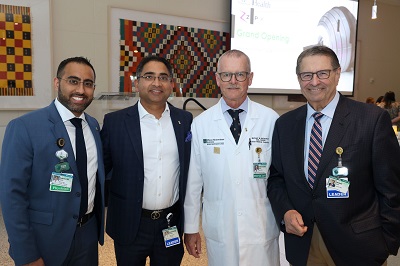
Dr. Rupesh Kotecha, Dr. Manmeet Ahluwalia, Dr. Michael McDermott and Dr. Michael Zinner
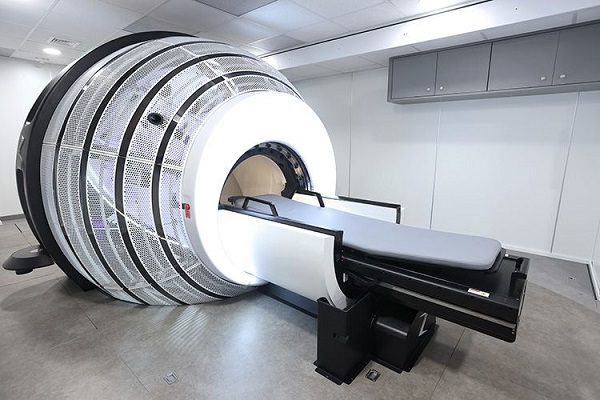
From its appearance, the gyroscopic linear accelerator could almost be mistaken for a futuristic space capsule or a napping pod, but it delivers highly precise radiation with hundreds of angled radiation beams directed at the target in the brain, sparing nearby vital tissues. Its innovative, self-shielding design requires no expensive, heavily shielded vaults that house other types of radiation equipment, and the healthcare team can be at the patient’s bedside safely.
“Because we have every stereotactic radiosurgery modality in one location, we can individually match the patient to the technology that is best suited for them,” said neurosurgeon Michael McDermott, M.D., chief medical executive of Miami Neuroscience Institute. “It’s giving patients better access to the care they need.” Stereotactic radiosurgery (SRS) is a non-invasive established treatment for many brain tumors.
The new technology requires most patients to undergo one to five treatments. Some conditions, such as trigeminal neuralgia may only need one session.
“Normally there are doors that weigh a couple of thousand pounds between us and our patients. Here, we can sit right next to them, and we can treat benign and malignant brain tumors, primary or metastatic, in usually a few short treatments,” said radiation oncologist Rupesh Kotecha, M.D., chief of radiosurgery and director of the Central Nervous System Metastasis Program at Miami Cancer Institute.
To prepare for the first session, patients undergo imaging studies that include MRI and CT scans. They are also fitted with a custom-made, pliable mesh face mask that helps keep their head in place during treatment. In addition, a simulation session ensures that everything is a go.
“The technology is the first new radiosurgery platform developed in over 30 years,” said Minesh Mehta, M.D., deputy director and chief of radiation oncology at Miami Cancer Institute. “The precision and safety requirements of cranial radiosurgery with this new platform are excellent. We are excited that we can offer our patients the latest technology available and that we can tailor therapy to each patient individually.”
Among the conditions that can be treated with the new SRS platform are:
- Glioblastomas and gliomas
- Acoustic neuromas
- Meningiomas
- Cerebral arteriovenous malformations
- Brain metastases
- Trigeminal neuralgia
- Pituitary adenomas
Research into other potential uses is ongoing.
For best outcomes, a collaborative healthcare team with vast experience is required due to the complexities of caring for patients with brain tumors and other functional disorders. At Miami Neuroscience Institute and Miami Cancer Institute, neurosurgeons, radiation oncologists, medical physicists, radiation therapists, and other specially trained employees work side by side.