By Jennifer Williamson
Navigational bronchoscopy technologies have transformed clinicians’ ability to biopsy hard-to-reach peripheral lung nodules. The latest evolution – robotic-assisted bronchoscopy (RAB) – is poised to surpass CT-guided transthoracic needle biopsy as the preferred approach for diagnosing early-stage lung cancer.
As an early adopter of RAB, Cleveland Clinic Indian River Hospital performed its first case in 2022. Since then, the hospital’s Lung Nodule Clinic has leveraged RAB to enhance precision, safety and diagnostic yield for patients with peripheral pulmonary nodules.
“Using robotic technology allows us to safely reach small, distal nodules with a very low risk of complication and achieve a highly accurate diagnosis, which ultimately leads to earlier treatment,” says Diego Maldonado, M.D., FCCP, Section Chief of Pulmonary and Critical Care at Indian River Hospital.
Collaborative research and standardization
Earlier this year, Indian River Hospital transitioned to a new robotic platform to align with Cleveland Clinic’s main campus in Ohio and sister sites in Florida. The Ion™ endoluminal robotic bronchoscopy system is one of three RAB platforms currently on the market that combines computer-assisted navigation with robotic catheter control.
“This platform change is an important step toward standardizing care, sharing data and facilitating collaborative research across the Cleveland Clinic enterprise,” Dr. Maldonado explains. “Our sites will be aligned in diagnostic yield, complications and other quality metrics, using the same standards and best practices.”
The coordinated use of a single system will also enable an enterprise-wide registry to advance RAB research – especially important given the absence of a national registry for robotic bronchoscopy outcomes.
Precision in the periphery
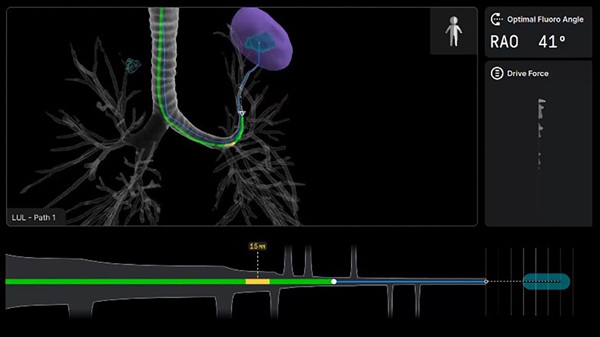
The Ion system uses shape-sensing fiber optics embedded along the catheter to provide real-time, three-dimensional positional and orientation feedback. This, combined with advanced algorithmic guidance and a small 3.5 mm scope diameter, allows access to distal airways that were previously unreachable with conventional bronchoscopes.
Pre-procedural high-resolution CT imaging generates a virtual bronchial map that guides navigation to the target nodule, while intraoperative cone-beam CT or three-dimensional fluoroscopy confirms “tool-in-nodule” positioning during biopsy.
“The new system is exceptionally precise because of the scope size, catheter stability and continuous 3D positional tracking,” notes Dr. Maldonado. “I can reach more distal nodules in the periphery with a high degree of accuracy.”
Cleveland Clinic’s three Florida sites and its main campus in Ohio will be among the first to receive newly approved software upgrades for the Ion system. These include AI-powered navigation that corrects CT-to-body divergence in real time and expanded imaging capabilities.
Changing practice patterns
The introduction of RAB at Indian River Hospital is already transforming lung cancer surveillance and management. In the pursuit of earlier diagnosis, when treatment is most effective, sub-centimeter nodules that were once monitored are now routinely biopsied.
“I can use robotic bronchoscopy to reach distal nodules as small as 0.5 centimeters,” Dr. Maldonado says.
Just five years ago, most of the lung cancers diagnosed by Dr. Maldonado were advanced stage. That trend is slowly shifting. “We’re turning things around with this technology – no question,” he adds.
Combining low-dose CT (LDCT) screening with molecular diagnostics such as proteomics and genomics enables much earlier detection in high-risk patients, especially smokers with small nodules. “If we have a patient with a 1-centimeter nodule who’s a heavy smoker with a strong family history of cancer, we don’t need to wait,” Dr. Maldonado explains.
From diagnosis to therapy
Looking ahead, Dr. Maldonado anticipates that RAB will continue to reshape lung cancer care. He points to ongoing studies exploring robotic-assisted bronchoscopy lung ablation using multiple energy modalities.
“Future advances in navigational accuracy and maneuverability will allow us to diagnose, stage and treat localized disease during a single operative session,” he said.