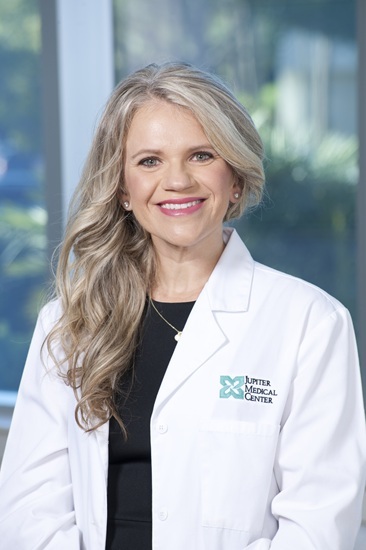


Informing a woman that she has breast cancer is always difficult for specialist Dr. Danielle Krol, but she’s often taken aback by what patients say to her next.
“‘What did I do wrong?’ is sometimes the first question women ask when they’re diagnosed with cancer,” acknowledges Dr. Krol, who recently joined Jupiter Medical Center’s Anderson Family Cancer Institute as a breast cancer specialist.
“People often want to know what they could have done to prevent cancer, but the reality is that you can’t change your age, your genes or your family history,” she explains, “Together, though, we can focus on what you can change, not the things you can’t.”
A mother’s diagnosis = inspiration
Inspired to pursue a medical career after her mother passed away from breast cancer at age 49, Dr. Krol specializes in breast cancer treatment while helping women understand cancer prevention and risk reduction—two areas that encompass multiple factors and data points.
A former ABC News medical journalist and medical oncologist for the U.S. Food & Drug Administration and the National Cancer Institute, Dr. Krol encourages women (and all cancer patients) to seriously examine their family history, genetics, lifestyle, diet and other risk factors throughout their lifetime to take advantage of oncology’s advances.
“I was 16 when my mother was diagnosed with breast cancer at age 46 and there was no such thing then as extended panel genetic testing,” she points out.
But women today have access to far more information, tests, preventive approaches and treatments for breast and other cancers so that they can identify and modify their risks throughout life. These are important capabilities now because some cancers – including breast, uterine, lung, pancreatic, colorectal and skin – are being detected in women as early as their 20s-30s-40s.
Is genetic testing right for you?
“In today’s society, genetic counseling is really vital for someone who has a strong family history of cancer, such as a mother or aunt who was diagnosed with breast cancer,” she says. “Genetic counselors are really good at translating complex genetic information into understandable risks, which helps people assess their lifetime risk of developing cancer.
“Ongoing advancements in technology have created a transformative impact in not only identifying genetic abnormalities in individuals at risk for developing cancer, but also for identifying cancer-cell genetic abnormalities, a capability that opens the door to developing targeted drug treatments,” she adds.
“A deep family history should also serve as impetus to talk to a family doctor or obstetrician-gynecologist about earlier mammograms, Pap tests and cancer screenings,” she says. Questions to consider when determining whether to pursue additional cancer screening(s) or an appointment with a genetics counselor include:
- Is there a family history (women and men) of specific cancers? Breast? Uterine? Ovarian? Cervical? Lung? Pancreatic?
- Have you been screened for the presence of the BRCA gene, which significantly increases the risk of breast and ovarian cancer?
- When was your last PAP test for cervical cancer?
- When was your last visit with an obstetrician/gynecologist?
- When was your last mammogram or physical breast exam?
- How frequently should your screenings be scheduled, and should other screening modalities be added?
- Should we explore preventive medications or surgeries, for example, if you’re at high risk for ovarian cancer?
- What is your risk, and what can we do to screen earlier for those specific cancers?”
Screening data = targeted treatments
Early treatment interventions and risk-modifying approaches are now available, including more frequent screenings/scans and chemoprevention (anti-hormone therapy) for patients with specific individual or family cancer risks, notes Dr. Krol. Lifestyle discussions and changes are important, too, especially about exercise, diet and consumption of processed foods, smoking, alcohol use, hormone replacement therapy history and other factors, she points out. Some studies, for example, highlight yoga’s benefit to ease pain, fatigue and depression among women recovering from breast cancer.
“My expertise is the treatment of breast cancer of all stages, but also cancer prevention in high-risk men and women,” she says. “I provide specialized care for individuals at high-risk for developing cancer and those with a high-risk of the cancer coming back after treatment.”
To make an appointment with Dr. Krol, please call The Anderson Family Cancer Institute at (561) 263-4400.