By Joey Garcia and Josh Baxt
From investigating dementia with Lewy bodies (DLB) and developing new tools to better screen patients to innovative genetic research, physician scientists with the University of Miami Miller School of Medicine continue to advance research for Alzheimer’s disease and dementia.
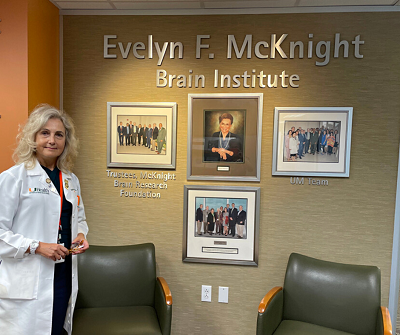
Dr. Tatjana Rundek
The Comprehensive Center for Brain Health and the Evelyn F. McKnight Brain Institute are among the major pillars of Alzheimer’s research at the Miller School and maintain a wide range of impactful studies that provide the local community and beyond with access to the most cutting-edge clinical trials and population health studies.
Dr. James Galvin, a nationally renowned Miller School neurologist who studies Alzheimer’s disease and DLB, is currently co-leading a $29 million National Institutes of Health grant to test whether a new drug, CT1812, is safe and effective for patients with DLB. The drug, called CT1812, is being developed by Dr. Galvin’s collaborators Cognition Therapeutics to treat both DLB and Alzheimer’s disease.
“When CT1812 was developed as a small molecule that modulates a receptor in the brain called sigma-2, they found it prevents the binding of the amyloid protein responsible for the major pathology in the brains of people with Alzheimer’s disease and blocks its toxic effects,” said Dr. Galvin, professor of neurology and director of UM’s Comprehensive Center for Brain Health. “But they also found CT1812 has a similar effect on alpha-synuclein protein, the building block for Lewy bodies depositing in the brains of people with DLB.”
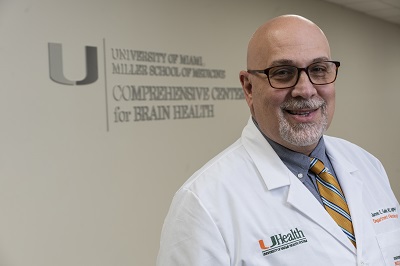
Dr. James Galvin
According to the Lewy Body Dementia Association, there are around 1.4 million people in the United States with DLB, making it the second-most prevalent cause of dementia after Alzheimer’s. Unfortunately, there are no approved drugs for the disease, forcing clinicians to prescribe off-label treatments to manage symptoms.
The NIH grant, one of the largest ever awarded to investigate DLB, will fund a multi-center phase 2 clinical trial in 120 DLB patients, which will primarily investigate whether CT1812 is safe. If the drug succeeds in phase 2, it could proceed to a larger phase 3 trial, which will focus on efficacy in a larger sample to determine if it’s suitable for approval by the Food and Drug Administration.
Researchers at the Miller School’s Evelyn F. McKnight Brain Institute have also joined several top-tier institutions in the Precision Aging Network (PAN).
The collaborative project aims to better understand the neural mechanisms that account for optimal brain performance in older-age adults and those that underlie age-related cognitive impairment and disorders such as Alzheimer’s disease.
“We will bring our expertise in recruiting underserved populations to enhance the applicability of the aging network results across diverse subjects,” said Dr. Ralph L. Sacco, professor and chairman of neurology, executive director of the Evelyn F. McKnight Brain Institute, and director of the Miami Clinical and Translational Science Institute.
As part of the study, information will be collected from a diverse population of American adults of different ages, ethnicities, and backgrounds by using the MindCrowd research project. The goal is to better understand human memory and risk factors for Alzheimer’s disease and recruit large numbers of participants online.
“This five-year program ‘Precision Aging Network (PAN): Closing the Gap Between Cognitive Healthspan and Human Lifespan’ will significantly advance our scientific knowledge of precision medicine concepts to predict individual brain health risks and provide personalized solutions to maximize cognitive health span,” said Dr. Tatjana Rundek, professor of neurology and Evelyn F. McKnight Endowed Chair for Learning and Memory in Aging and a principal investigator of the PAN Miami site. “It is an extremely exciting and novel program that will extend our collaborations with the University of Arizona and other partners.”
Recruiting participants from such diverse regions of the country will ensure large numbers of Hispanic, Black, and other racial and ethnic minorities are represented — an essential goal of the study since those populations have been historically underrepresented in aging literature.