
By Mary C. Mayhew
Florida is a national leader in prioritizing investments to grow the healthcare workforce to meet Floridians’ healthcare needs today, tomorrow, and decades into the future. But, these investments are undermined by the state’s uncapped medical professional liability environment and resulting nuclear verdicts.
Runaway nuclear verdicts in medical liability cases – jury awards that exceed $10 million in lawsuits involving personal injury or wrongful death claims – are contributing to the rising cost of healthcare through exorbitant medical malpractice premiums and litigation costs. They are also inhibiting physicians’ willingness to practice in higher-risk specialties, like obstetrics and, most importantly, are reducing Floridians’ access to timely medical care when they need it. Fewer physicians means longer wait times to see a specialist, worsening medical conditions, increased unnecessary use of the emergency department and hospitalizations, and overall higher healthcare costs.
There is a solution. Patients experiencing medical malpractice can get justice, the system can work as intended to hold negligent providers accountable, and physicians can afford to practice in Florida.
The solution is to reinstate enforceable caps on non-economic damages – the payments for emotional suffering. The caps would not apply to compensation for direct medical costs or earnings losses. These caps are a reasonable reform and common-sense limitation on the medical malpractice system.
Between 2013 and 2022, Florida had the second-most reported nuclear verdicts in the country (behind only California), and the most per capita, with 197 reported cases totaling $33 billion in awards. The threat of these devastating nuclear verdicts holds hospitals and clinicians hostage, forcing them to settle out of court, regardless of the merits of the case.
In 2025, for example, a Hillsborough County jury awarded $51 million in non-economic damages, which exceeded the figure sought by the plaintiff by a factor of 2.5, compelling the judge to step in and reduce the award, finding that the “jury’s passions were inflamed.”
These verdicts are too costly because we cannot afford to lose any Florida physicians, and Floridians deserve access to timely care wherever they live in the state.
Physician supply in Florida is projected to meet only 77 percent of projected need by 2035, in part because of the state’s overall population growth and increasing number of elderly individuals who will need more medical care. In addition, for obstetrics specifically, 40 percent of obstetricians who reported in 2025 that they plan to discontinue providing obstetric care within the next two years attributed their decision to liability concerns.
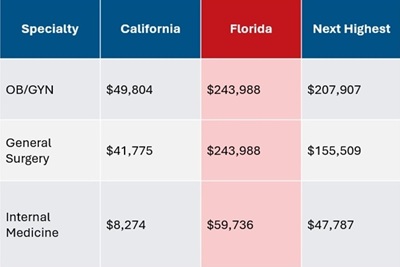
Florida has exceptionally high medical malpractice insurance costs, which are driven in large part by nuclear verdicts. Obstetricians in Miami-Dade County, for example, can pay as much as $226,000 annually for malpractice coverage — 454 percent more than their peers in Los Angeles County in California, a state that has capped noneconomic damages for decades, according to the American Medical Association. For internists practicing in Miami-Dade, their malpractice premiums are 677 percent greater than for their counterparts in L.A.
Medical Professional Liability Premiums, 2025
Texas introduced comprehensive tort reform more than 20 years ago that includes a $250,000 cap on non-economic damages and, as a result, experienced a significant reduction in both the number of medical malpractice claims and the cost of malpractice insurance premiums and, importantly, also experienced an increase in the number of physicians relocating to Texas.
In the first almost-decade after Texas enacted tort reform, the number of medical malpractice claims fell by nearly two-thirds, and the state’s largest malpractice carrier reported nine consecutive years of reduced malpractice premiums. The state’s medical association reported an almost 50 percent reduction in the cost of malpractice premiums for Texas doctors.
In addition, in the decade following tort reform, by multiple metrics, the number of physicians practicing in Texas increased. Seventeen of the state’s 22 trauma service areas experienced a per-capita increase in direct patient care physicians between 2006 and 2011, and the state medical board licensed more than 28,000 new physicians between 2003 and 2013.
Florida can do the same. Thanks to legislative investments, Florida is making tremendous strides in creating more physician training opportunities, but we need to ensure the physicians who are training here stay here to practice. And we need to retain our current supply of practicing physicians. Key to achieving both goals is reasonable medical malpractice reform, including capping non-economic damages to prevent runaway nuclear verdicts. Timely access to care from our largest cities to our smallest rural communities depends on it.
Mary Mayhew is President and CEO, Florida Hospital Association.